
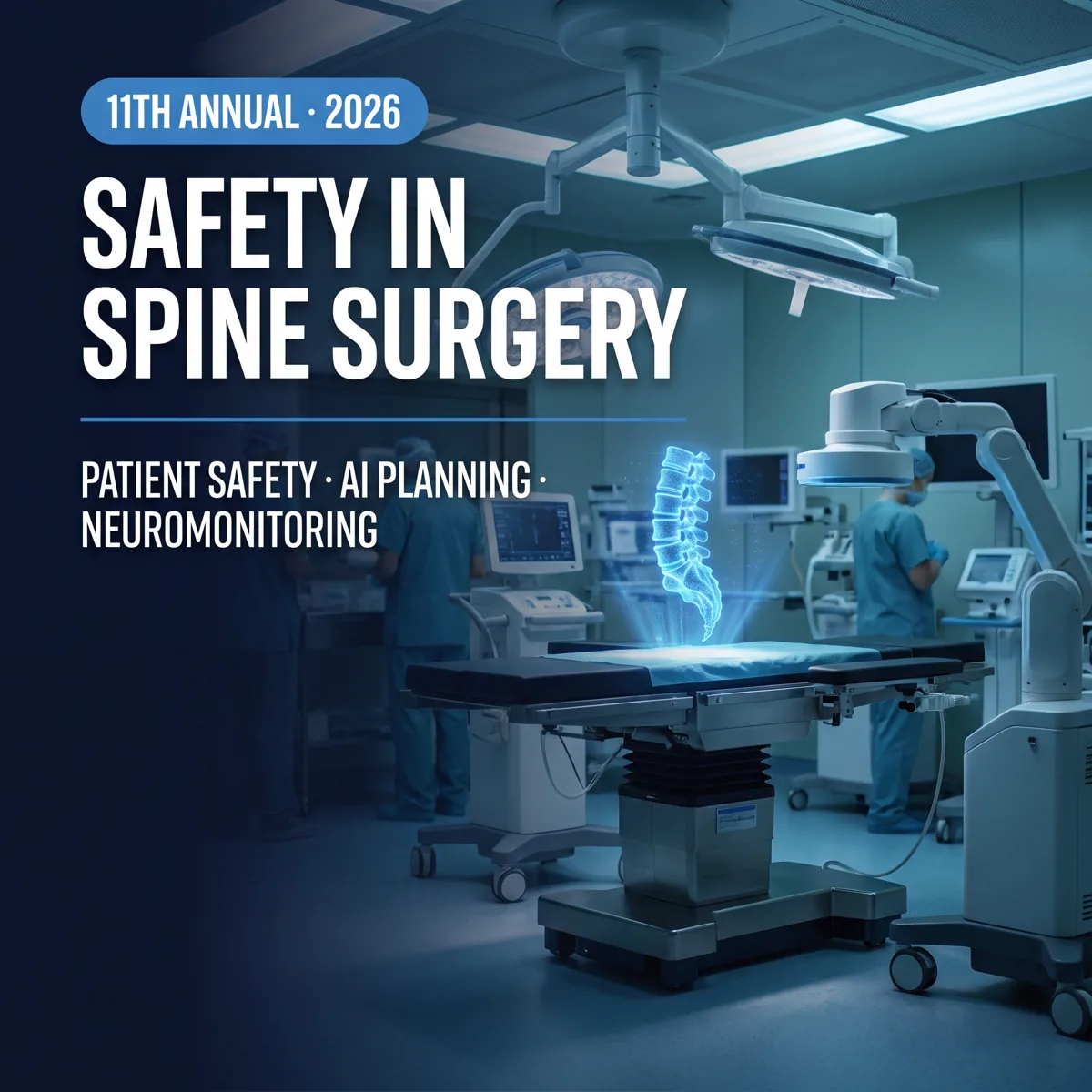
The Safety in Spine Surgery Summit 2026 – 11th Annual Meeting brings together expert spine surgeons and multidisciplinary specialists to discuss current strategies for improving patient safety, surgical planning, intraoperative performance, complication prevention, and outcomes in spine surgery.
The 2026 program focuses on important areas including human factors and cognitive safety, AI-assisted surgical planning, spinal deformity surgery, intraoperative neuromonitoring, hemodynamic and blood management, radiation exposure, preoperative optimization, technology integration, and prevention of wrong-level spine surgery.
What’s included
- Format: video lectures with subtitles
- 20 video lectures
- No PDF files or presentation slides
- 11th Annual Safety in Spine Surgery Summit (2026)
- Self-study material; does not include CME or MOC credit.
Video lectures
- How Can Surgeons Reduce Wrong-Level Spine Surgery in Patients With Variant Anatomy? — Benjamin Roye (09:20)
- Spine Surgery Ergonomics: Strategies to Reduce Occupational Injury and Improve Career Longevity — David Skaggs (09:58)
- Cognitive Fatigue in Spine Surgery: Preventing Autopilot Errors in the Operating Room — Gregory Mundis (10:27)
- AI in Adult Spinal Deformity: Improving Surgical Planning and Outcome Prediction — Joseph Lombardi (08:23)
- Spinal Deformity Surgery: Patient-Specific Planning and Technology Selection — Eduardo Beauchamp (08:27)
- Utilizing Technology to Improve Surgeon Efficiency and Safety in Spine Surgery — Han Jo Kim (10:13)
- When Should Plastic Surgeons Be Involved in Complex Spine Surgery? — Thomas A. Imahiyerobo (08:52)
- Hemodynamic Management in Spine Surgery: Reducing Complications Through Goal-Directed Therapy — Josephine Coury (06:17)
- Blood Management in Spine Surgery: Is Routine Cell Salvage Always Necessary? — Venu Nemani (08:36)
- Adult Spinal Deformity: Seven Years of Safer Surgery and Fewer Medical Complications — Austin Kaidi (05:14)
- Postoperative MAP Management Following Neuromonitoring Changes in Pediatric Spine Surgery — Michaela O’Connor (04:43)
- AI-Assisted Intraoperative Neuromonitoring in Pediatric Spinal Deformity Surgery — Varun Arvind (04:43)
- Pedicle Screw Revision After Lumbar Fusion: Economic and Radiation Costs — Renzo Laynes (04:29)
- Intraoperative Radiation Exposure in Spine Surgery: A Decade of Advanced Imaging — Kento Yamanouchi (04:49)
- Early-Onset Scoliosis: Spine Surgery Safety With Implanted Programmable Devices — Walter Troung (05:52)
- Adolescent Idiopathic Scoliosis: Impact of Postoperative Anemia on Recovery After Surgery — Josephine Coury (04:21)
- Vertebral Artery Injury During Cervical Spine Surgery: A Practical Management Algorithm — Ayesha Waheed (04:38)
- Preoperative Planning for Adult Spinal Deformity: From Patient Optimization to Surgical Execution — Zeeshan Sardar (08:17)
- Multidisciplinary Optimization for Neuromuscular Scoliosis: Building Safer Care Pathways — Tenner Guillaume (09:33)
- Lifestyle Medicine for Spine Surgery: A Multidisciplinary Approach to Preoperative Optimization — Heidi Prather (10:26)
Topics covered
Human Factors & Cognitive Safety
Cognitive fatigue, autopilot errors, surgical ergonomics, wrong-level surgery prevention, and human factors that influence decision-making and performance in the operating room.
AI, Technology & Surgical Planning
The growing role of artificial intelligence and advanced technology in spine surgery, including AI-assisted planning, outcome prediction, intraoperative neuromonitoring, technology selection, and strategies for improving surgeon efficiency and safety.
Adult & Pediatric Spinal Deformity
Adult spinal deformity, pediatric spinal deformity, early-onset scoliosis, adolescent idiopathic scoliosis, and neuromuscular scoliosis, with emphasis on safer surgical pathways and complication reduction.
Intraoperative & Perioperative Safety
Hemodynamic management, blood management and cell salvage, postoperative MAP management, intraoperative neuromonitoring, radiation exposure, pedicle screw revision, complex wound management, and prevention and management of vascular injury.
Preoperative Optimization
Patient-specific surgical planning, multidisciplinary optimization, lifestyle medicine, and preparation of higher-risk spine surgery patients before operative intervention.
Who should attend
- Orthopedic spine surgeons
- Neurosurgeons
- Pediatric spine surgeons
- Spine surgery fellows and residents
- Orthopedic and neurosurgery trainees
- Anesthesiology professionals involved in spine surgery
- Intraoperative neuromonitoring professionals
- OR and perioperative team members
- Healthcare professionals involved in spine quality and patient safety
Reviews
There are no reviews yet