
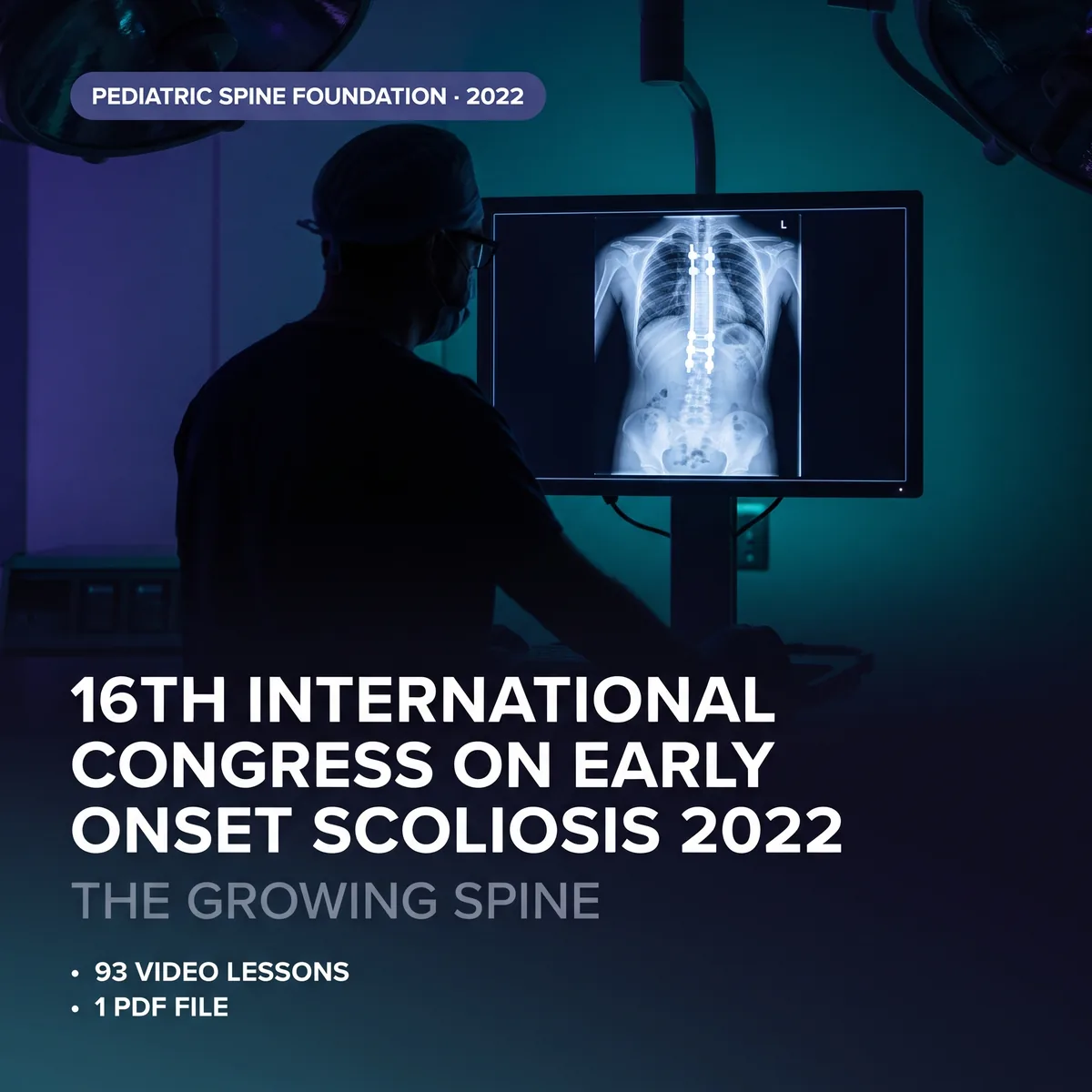
16th International Congress on Early Onset Scoliosis & the Growing Spine 2022 is a recorded course comprising 93 video lectures.
What’s included
- 93 video lectures · 1 PDF file
- On-demand streaming access to the recorded sessions
- Self-study material; does not include CME or MOC credit.
What you’ll learn
- Understand current research and best practices in analysis and decision-making in the management of early onset scoliosis and complex spinal deformities in the growing child.
- Describe the indications, rationale and surgical techniques for the surgical management of early onset scoliosis and complex spinal deformities in the growing child.
- Discuss the role of vertebral body tethering to treat complex growing spine deformities.
- Describe ways to prevent and manage complications associated with spine surgery for early onset and pediatric patients.
- Describe treatment for and minimize complications of infection and neurologic damage.
- Generate a long term plan for patients undergoing treatment for EOS.
Course contents
- Session 1 3 stage graduation Removal, HGT, Final Fusion
- Session 1 EOS Graduation Our decision-making journey in the past 20 years
- Session 1 How to know when observation is not working
- Session 1 I prefer final fusion for all
- Session 1 I’m happy just leaving MCGR and follow
- Session 1 I’m happy to stop lengthening and follow (non-MCGR)
- Session 1 Stop lengthening Who, when, and why
- Session 2 How much should we be cleaning up the MCGR debris
- Session 2 Level selection case examples
- Session 2 Managing the PJK case examples
- Session 2 Revision surgeries following definitive fusions
- Session 2 The role of osteotomies across lengthy autofusion
- Session 4 Brace is best for the patient, parent, and surgeon
- Session 4 Cast is best for the patient, parent, and surgeon
- Session 4 Classifying EOS and its guide to treatment
- Session 4 Combination of brace and cast is the best of both worlds
- Session 4 Debate 2-year-old with a small curve Cast vs. Brace
- Session 4 EOS is a 3D deformity
- Session 4 Growth-friendly implants-the effects on growth and 3D correction
- Session 4 Pulmonary function now and where it will be in 5 years
- Session 4 Understanding EOSQ and measuring outcomes
- Session 4 Understanding spinal growth
- Session 5 Children with Presumed Early-Onset Idiopathic Scoliosis Treated with Casting May Have Delayed Ambulation
- Session 5 Definition of Tweener Consensus Among Experts in Treating Early Onset Scoliosis
- Session 5 Does Magnetically Controlled Growing Rod Surgery Improve Nutritional Status in Early Onset Scoliosis Patients
- Session 5 Growth Friendly Surgery Increases 3D True Spine Length at 2-Years Post-Op
- Session 5 Is Spine Straightness Correlated with Mental Health in Early-Onset Scoliosis Patients Treated with Growing Rods
- Session 5 Parent Requests to Stop Spine-Lengthening Treatment and Impact on EOSQ-24 Scores
- Session 5 Spirometry Outcomes in an Orthopedic Clinic Setting vs Pulmonary Function Laboratory for Children with EOS
- Session 6 Complications of MCGRs and TGRs in the Management of EOS A Multicenter Database Study of 800 Patients
- Session 6 Early Onset Scoliosis and Growing Spine Past, Present and the Future
- Session 6 Money Can’t Buy Happiness, But Can It Buy Less Complications and UPRORs in Growth Friendly Surgery
- Session 6 Q&A Part 1
- Session 6 Q&A Part 2
- Session 6 Unplanned Return to the Operating Room (UPROR) Occurs in Half of MCGR Patients at 2 Years After Initial Implantation
- Session 7 Case-Based Learning My Ideal First Case-VBT
- Session 7 Complex EOS Case Presentation: 20 Month Old, FTT, Presumed Idiopathic
- Session 7 EOS Case Where I Should Have Chosen Differently
- Session 7 EOS Cases Ideally, I Have Tried Everything, Now What Should I Have Chosen Differently
- Session 7 Multiple Revisions Prader-Willi. What to Do Next
- Session 7 My Ideal First Case Posterior Dynamic Device
- Session 7 PDD Case-Based Learning My Ideal First Case – Shilla Growth Guidance Surgery (GGS)
- Session 7 Rib-based Implants
- Session 7 Spine based MCGR
- Session 8 Congenital cervicothoracic junction scoliosis
- Session 8 Congenital spinal dislocations
- Session 8 Infected implant
- Session 8 Management of SMA
- Session 8 Management of TL kyphosis
- Session 8 Occipital-Cervical fusion
- Session 8 Rigid kyphosis
- Session 8 Severe pelvic obliquity
- Session 9 Can We Definitely Avoid Spinal Fusion Surgery for Progressive Early Onset Neuromuscular Scoliosis
- Session 9 High Rates of Implant Failure After Growth-Friendly Scoliosis Surgery for Patients with Prader-Willi Syndrome
- Session 9 Outcomes of Growth-Friendly Instrumentation in Osteogenesis Imperfecta
- Session 9 Proximal Junctional Kyphosis in Growth Guidance Systems for Early Onset Scoliosis
- Session 9 Risk Factors for Fusion Failure in Children Undergoing Occiput to C2 Rigid Instrumentation and Fusion
- Session 10 Back Pain in Children Under 10 Years Old Referred with Spine Concerns
- Session 10 Differential Vertebral Growth Is Maintained 4 Years After Vertebral Body Tethering Surgery for Idiopathic Scoliosis
- Session 10 Five-Year Pulmonary Function After Index and Revision Vertebral Body Tethering (VBT)
- Session 10 Growth Modulation Significantly Increases the Chance of Postop Success Following VBT
- Session 10 Intraoperative Correction Associated with VBT Success at 2-Year Follow-Up
- Session 10 Modern Luque Trolly Self Growing Rods Construct for the Treatment of EOS 3.5 Years Follow Up
- Session 10 Risk Factors for, and Impacts of Autofusion in Early Onset Scoliosis Growing Constructs
- Session 10 Self Sliding Growth Guidance for EOS Clinical and Radiological Results After a Minimum of Six Years (6-14) of Follow-Up
- Session 10 The Evaluation of Serum Metal Ion Levels and Metallosis in Patients with MCGR
- Session 10 The Lower Instrumented Vertebra Dilemma in Growing Rod Surgery
- Session 10 The Magic Behind the Magnets in the Magnetically Controlled Growing Rods
- Session 10 There Is No Magic to It Lengthening Behavior of Magnetically Controlled Growing Rods in Early Onset Scoliosis
- Session 11 Cases we still don’t have solutions for
- Session 11 I should have delayed to a definitive fusion
- Session 11 I should have gone to the front of the spine
- Session 11 I should not have gone to the pelvis
- Session 11 I should not have gone to the ribs
- Session 11 I should not have removed the implants
Who should attend
- This course is designed for orthopaedic and neurological surgeons, fellows, and residents who include pediatric spinal deformity surgery in their practices. Nurses, nurse practitioners, physician assistants, and physicians providing non-operative care of spinal deformities may also benefit from the course.
Reviews
There are no reviews yet